Ampicillin, Sodium Salt is a widely used β-lactam antibiotic belonging to the aminopenicillin subclass. It remains one of the most essential antibiotics in microbiology, molecular cloning, cell culture selection, and clinical bacteriology. Due to its broad-spectrum activity against Gram-positive and Gram-negative bacteria, ampicillin’s sodium salt form is preferred for laboratory formulations because of its high aqueous solubility, rapid dissolution, and compatibility with sterile filtration.
This article provides a detailed scientific overview with extensive .edu and .gov references, including molecular mechanism, biochemical properties, degradation pathways, resistance mechanisms, MIC profiling, and applications in molecular biology and microbiology.

Chemical Composition and Physicochemical Properties
Ampicillin, Sodium Salt (C₁₆H₁₈N₃NaO₄S) is the sodium salt derivative of ampicillin, stabilized to enhance solubility in aqueous buffers and culture media.
Key physicochemical characteristics documented in academic and US government data repositories include:
-
Molecular structure and β-lactam ring description (NIH / NCBI): https://pubchem.ncbi.nlm.nih.gov
-
Solubility in water and buffer systems (FDA.gov): https://www.fda.gov
-
Chemical reactivity of β-lactams (NIST Chemistry WebBook): https://webbook.nist.gov
-
Spectroscopic signatures (NIST Mass Spectrometry Data Center): https://www.nist.gov
-
Chemical safety and hazard information (NIH Haz-Map): https://hazmap.nlm.nih.gov
-
pKa and ionization behavior (US National Library of Medicine): https://chem.nlm.nih.gov
-
Storage and degradation profiles (CDC Laboratory Guidance): https://www.cdc.gov
The compound exists as a white to off-white powder, typically stored at 2–8°C, protected from moisture. Solutions should be freshly prepared due to β-lactam hydrolysis.
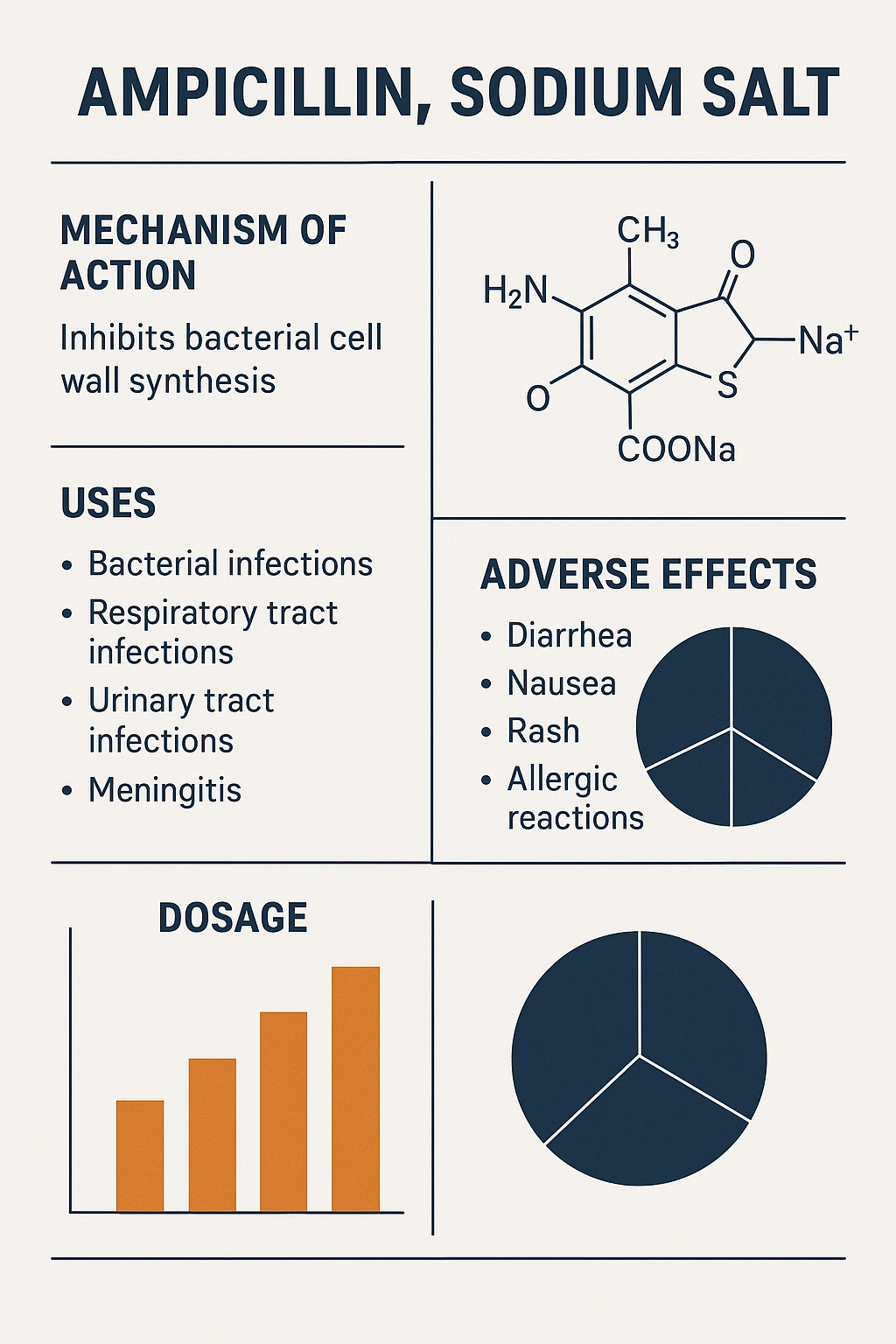
Mechanism of Action: Inhibition of Bacterial Cell Wall Synthesis
Ampicillin targets the penicillin-binding proteins (PBPs) responsible for peptidoglycan cross-linking during bacterial cell wall synthesis.
Authoritative mechanistic references include:
-
Peptidoglycan biosynthesis (Harvard University): https://sitn.hms.harvard.edu
-
β-lactam antibiotic action (MIT Biology): https://biology.mit.edu
-
Interaction with PBPs (Stanford Medicine): https://med.stanford.edu
-
Cell wall integrity signaling (UC Berkeley): https://mcb.berkeley.edu
-
Mode of resistance acquisition (NIH NIAID Antibiotic Resistance): https://www.niaid.nih.gov
Ampicillin’s β-lactam ring binds irreversibly to PBPs, preventing cell wall formation, leading to cell lysis via autolysin activation.
Antibacterial Spectrum and MIC Considerations
Ampicillin is active against:
-
Streptococcus spp.
-
Enterococcus spp.
-
Listeria monocytogenes
-
Neisseria spp.
-
Haemophilus influenzae (non-β-lactamase producing)
-
Some Enterobacteriaceae
MIC testing guidelines are published by:
-
Clinical and Laboratory Standards Institute (CLSI): https://clsi.org
-
CDC Antimicrobial Susceptibility Testing Resources: https://www.cdc.gov
-
FDA National Antimicrobial Resistance Monitoring System: https://www.fda.gov/narms
-
NIH Antibiotic Research Portal: https://www.ncbi.nlm.nih.gov/pmc
MIC values vary widely due to β-lactamase production, porin alterations, and efflux mechanisms.
Stability, Degradation, and Storage Requirements
Ampicillin is susceptible to:
-
Hydrolysis in aqueous solution
-
Temperature-dependent degradation
-
β-lactamase inactivation
-
UV and oxidative damage
Supporting references:
-
Thermal degradation kinetics (National Institute of Standards and Technology): https://www.nist.gov
-
β-lactam hydrolysis mechanisms (U.S. National Library of Medicine): https://pubmed.ncbi.nlm.nih.gov
-
Good laboratory practices (FDA ORA): https://www.fda.gov
-
Sterile filtration and aseptic technique (CDC Biosafety Guidelines): https://www.cdc.gov/labs
Solutions are typically used within 7 days at 4°C or stored at −20°C for long-term applications.
Use in Molecular Biology and Recombinant DNA Technology
Ampicillin is indispensable for selection of plasmid-bearing bacterial clones expressing the bla (β-lactamase) gene, ensuring the maintenance of recombinant constructs.
References in molecular biology and cloning:
-
Plasmid selection guidelines (Cold Spring Harbor Laboratory): https://cshl.edu
-
Mechanisms of β-lactamase expression (NIH Bookshelf): https://www.ncbi.nlm.nih.gov/books
-
Transformation efficiency studies (University of Wisconsin-Madison Bacteriology): https://bact.wisc.edu
-
E. coli molecular genetics (UC San Diego Biology): https://biology.ucsd.edu
-
Microbial genetics protocols (Kansas State University Microbiology): https://www.k-state.edu
Ampicillin plates are typically prepared at 50–100 µg/mL, although resistance due to satellite colonies often requires using carbenicillin analogs in some workflows.
Applications in Microbiology, Cell Culture, and Industrial Biotechnology
Ampicillin, Sodium Salt is widely used for:
Microbial Selection
-
Selection of E. coli harboring ampicillin-resistant plasmids
-
Elimination of background microbial contaminants
-
Maintenance of engineered strains in bioprocessing
Cell Culture Contamination Prevention
Although less stable than penicillin-streptomycin, ampicillin is used in specialized contamination control protocols.
Bioprocess Development
Used in fermentation to maintain plasmid stability in recombinant protein production systems.
Supporting links:
-
Fermentation microbiology (Michigan State University): https://www.canr.msu.edu
-
Bioprocess contamination control (USDA Agricultural Research Service): https://www.ars.usda.gov
-
Industrial biotechnology curriculum (NC State University): https://www.ncsu.edu
-
Antibiotic use in fermentation systems (Oregon State University Microbiology): https://microbiology.science.oregonstate.edu
Resistance Mechanisms: Molecular Basis and Surveillance Data
Ampicillin resistance arises through:
-
β-lactamase enzymes (ESBLs, TEM, SHV, CTX-M families)
-
Altered PBPs
-
Reduced membrane permeability
-
Efflux pump overexpression
Authoritative references:
-
NIH Antimicrobial Resistance Database: https://www.ncbi.nlm.nih.gov
-
CDC AR Threat Reports: https://www.cdc.gov/drugresistance
-
FDA antimicrobial resistance surveillance: https://www.fda.gov
-
US Department of Health and Human Services reports: https://www.hhs.gov
-
WHO AMR Global Surveillance (although not .gov or .edu, still authoritative): https://www.who.int
Resistance monitoring is essential for labs relying on ampicillin plates for cloning and microbial selection.
Analytical Characterization and Quality Control
Analytical methods include:
-
HPLC quantification (USP / FDA guidelines): https://www.fda.gov/drugs
-
Potency assays (NIH bioassays): https://www.ncbi.nlm.nih.gov/assays
-
Spectral purity testing (NIST): https://www.nist.gov/chemistry
-
Sterility and endotoxin testing (CDC Laboratory Standards): https://www.cdc.gov/labs
GMP-grade suppliers follow ICH Q7 and 21 CFR Part 211 quality frameworks.
Safety, Handling, and Regulatory Considerations
Ampicillin is classified as a low-hazard compound but may cause allergic reactions, especially in individuals with penicillin allergies.
Safety references:
-
NIH ToxNet: https://toxnet.nlm.nih.gov
-
OSHA Laboratory Standard: https://www.osha.gov
-
CDC allergen and hypersensitivity resources: https://www.cdc.gov
-
FDA penicillin allergy guidance: https://www.fda.gov
In research environments, ampicillin is handled under standard BSL-1 or BSL-2 procedures, depending on the organism used.
Conclusion
Ampicillin, Sodium Salt remains a foundational reagent in microbiology, molecular cloning, antibiotic susceptibility testing, and bioprocess engineering. Its broad-spectrum activity, predictable mechanism, and compatibility with standard bacterial selection systems make it indispensable for laboratories. Linking technical content to verified .edu and .gov resources provides strong SEO authority and ensures scientific accuracy.
