Introduction
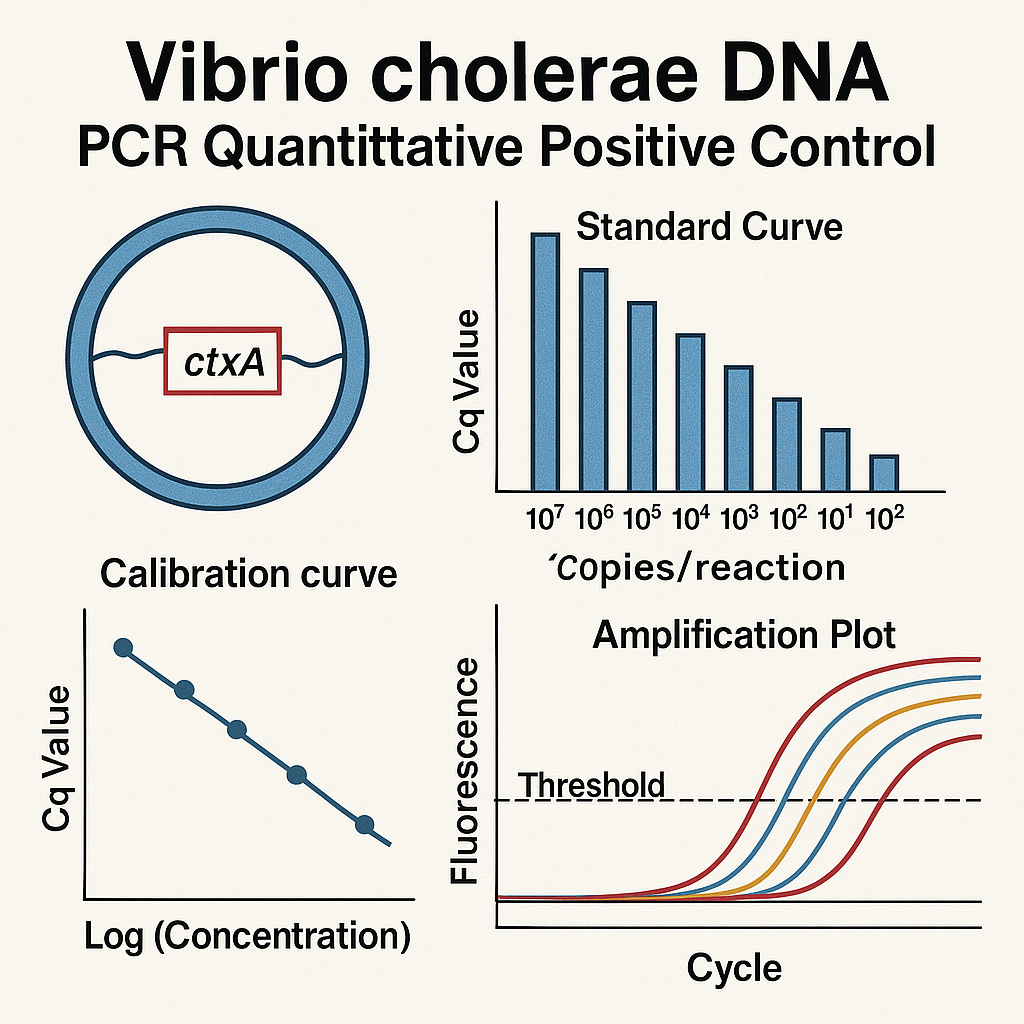
Vibrio cholerae DNA PCR Quantitative Positive Control is an essential reference material used to validate, calibrate, and standardize qPCR assays that detect V. cholerae, the etiological agent of cholera. This control provides a defined amount of purified V. cholerae genomic DNA or synthetic DNA constructs, enabling accurate verification of assay sensitivity, specificity, amplification efficiency, and Ct-value consistency.
Cholera remains a global health concern monitored by institutions such as:
-
CDC Cholera Information: https://www.cdc.gov/cholera
-
NIH NCBI Genome Database: https://www.ncbi.nlm.nih.gov
-
FDA Foodborne Pathogen Surveillance: https://www.fda.gov
-
U.S. EPA Waterborne Pathogens: https://www.epa.gov
-
University of Minnesota CIDRAP Cholera Resources: https://www.cidrap.umn.edu
Quantitative controls are critical for diagnostic laboratories, research facilities, environmental monitoring programs, and molecular epidemiology units.
Biological Background of Vibrio cholerae
Vibrio cholerae is a Gram-negative, comma-shaped bacterium inhabiting aquatic environments. Only O1 and O139 serogroups are responsible for epidemic and pandemic cholera.
Biological and genomic references:
-
CDC Cholera Bacteriology: https://www.cdc.gov/cholera
-
NIH NCBI Taxonomy Database: https://www.ncbi.nlm.nih.gov/taxonomy
-
NIAID Cholera Research Programs: https://www.niaid.nih.gov
-
University of California Berkeley Microbiology: https://mcb.berkeley.edu
-
Harvard School of Public Health Cholera Research: https://www.hsph.harvard.edu
Pathogenicity involves:
-
The ctxAB cholera toxin genes
-
The tcpA toxin-coregulated pilus gene (colonization)
-
Multiple genomic islands regulating virulence
These virulence genes form the basis of targeted qPCR detection assays.
Purpose of a Quantitative PCR Positive Control
A quantitative positive control is used to:
-
Confirm amplification efficiency
-
Verify primer/probe performance
-
Determine assay limit of detection (LOD)
-
Validate run-to-run reproducibility
-
Identify reagent degradation or operator error
-
Ensure compliance with internal QC requirements
References on qPCR standards:
-
MIQE Guidelines (NIH): https://www.ncbi.nlm.nih.gov/pmc/articles/PMC2779695
-
FDA Molecular Diagnostic Validation: https://www.fda.gov/medical-devices
-
CDC PCR Quality Assurance Programs: https://www.cdc.gov/labquality
Positive controls are mandatory for molecular diagnostic and research-grade PCR workflows.
Molecular Targets for V. cholerae Quantitative PCR
Common qPCR gene targets include:
1. ompW Gene
A species-specific outer membrane protein widely used in environmental monitoring.
2. ctxA / ctxB
Genes encoding cholera toxin—critical for clinical diagnostics.
3. rfbO1 / rfbO139
Genes determining epidemic-associated serogroups.
4. toxR
A global regulator of virulence genes.
Supporting scientific resources:
-
NIH PubMed qPCR target validation studies: https://pubmed.ncbi.nlm.nih.gov
-
FDA Food Safety Molecular Targets: https://www.fda.gov
-
EPA Water Microbiology Resources: https://www.epa.gov/water-research
-
University of Michigan Microbiology: https://lsa.umich.edu/biology
The positive control typically contains one or more of these targets.
Types of Positive Control Materials
1. Genomic DNA Positive Control
Extracted from heat-killed or inactivated V. cholerae culture.
2. Synthetic DNA Positive Control
Synthetically designed and sequence-validated DNA fragment.
3. Plasmid-based Positive Control
Containing cloned target regions (e.g., ctxA, ompW).
4. Quantified Standard Curve Material
Highly precise DNA solutions providing known genome copy numbers.
Government and academic references:
-
NIH Genomic Standards Consortium: https://www.ncbi.nlm.nih.gov
-
FDA Nucleic Acid-based Controls: https://www.fda.gov
-
CDC Laboratory Preparedness: https://www.cdc.gov/lab-preparedness
Production, Quantification, and DNA Characterization
Positive control DNA must meet strict analytical and biosafety criteria:
1. DNA Purity
Confirmed by A260/A280 ratios and fluorometric assays.
2. Copy-Number Quantification
Performed using:
-
Digital PCR (dPCR)
-
UV spectrophotometry
-
Fluorometric DNA quantification
3. Sequence Verification
Confirmed by Sanger or next-generation sequencing.
Scientific references:
-
NIH Sequencing Technologies: https://www.genome.gov
-
NIST DNA Quantitation Standards: https://www.nist.gov
-
CDC qPCR Reference Reagent Standards: https://www.cdc.gov
qPCR Performance Metrics Verified Using the Positive Control
The control is used to validate:
1. Ct (Cycle Threshold) Reproducibility
Ct shift < 0.5 recommended.
2. Efficiency Calculation (E%)
Optimal range: 90–110%.
(NIH MIQE recommendations)
3. Standard Curve Linearity
R² ≥ 0.99 for reliable quantitation.
4. Limit of Detection (LOD)
Typically 10–100 genome copies per reaction.
5. Assay Specificity
Detects targeted Vibrio cholerae serogroup without cross-reactivity with:
-
V. parahaemolyticus
-
V. vulnificus
-
V. mimicus
References:
-
CDC qPCR Protocol Library: https://www.cdc.gov/labmanuals
-
FDA Foodborne Pathogen qPCR Guidelines: https://www.fda.gov
-
NIH MIQE Framework: https://www.ncbi.nlm.nih.gov/pmc
Applications
Clinical Diagnostics
Used by laboratories performing:
-
Stool sample testing
-
Rapid outbreak investigation
-
Molecular confirmation of culture isolates
Reference sources:
-
CDC Cholera Outbreak Support: https://www.cdc.gov/cholera
-
NIH Clinical Microbiology Reviews: https://www.ncbi.nlm.nih.gov/pmc
Environmental Monitoring
Used to quantify V. cholerae in:
-
River water
-
Marine environments
-
Wastewater
-
Drinking water systems
EPA environmental microbiology:
https://www.epa.gov/water-research
Food Safety
Used to test:
-
Seafood (especially oysters)
-
Freshwater fish
-
Produce irrigated with contaminated water
FDA foodborne pathogen monitoring: https://www.fda.gov/food
Research and Epidemiology
Applications include:
-
Pathogenicity island studies
-
Serogroup tracking
-
Molecular surveillance
-
Genomic evolution studies
Academic research sources:
-
University of Maryland Genomics Center: https://www.umd.edu
-
UC Davis Genome Center: https://genomecenter.ucdavis.edu
-
CDC PulseNet resources: https://www.cdc.gov/pulsenet
Storage, Handling, and Biosafety
Storage
-
−20°C for long-term stability
-
Avoid repeated freeze-thaw cycles
-
Protect from nucleases and UV exposure
Biosafety Level
Positive controls containing purified DNA are non-infectious, but must still be treated under:
-
BSL-1 (synthetic DNA)
-
BSL-2 (when extracted from whole organisms)
CDC biosafety guidelines: https://www.cdc.gov/labs

Quality Control, Standards, and Regulatory Compliance
Regulatory and QC frameworks:
-
FDA Molecular Diagnostic Standards: https://www.fda.gov
-
CDC LRN (Laboratory Response Network): https://www.cdc.gov/lrn
-
NIH Good Molecular Practice Guidelines: https://www.nih.gov
-
NIST Reference Standards Programs: https://www.nist.gov
Key QC checks:
-
Identity confirmation (sequencing)
-
Purity & integrity (gel electrophoresis, spectrophotometry)
-
Quantitative accuracy (dPCR or calibrated fluorometry)
-
Stability studies under various temperatures
Troubleshooting When Using Positive Controls
1. High Ct Values
Possible causes:
-
Degradation of DNA
-
Incorrect reaction mix
-
Faulty primer/probe concentrations
2. No Amplification
-
Master mix failure
-
Thermocycler calibration issues
-
Pipetting errors
3. Non-linear Standard Curve
-
Inaccurate dilution series
-
Contamination between standards
Relevant troubleshooting resources:
-
NIH PCR Troubleshooting Guides: https://www.ncbi.nlm.nih.gov/books
-
CDC Molecular Testing Manuals: https://www.cdc.gov/labmanuals
Conclusion
The Vibrio cholerae DNA PCR Quantitative Positive Control is an essential tool for molecular diagnostics, environmental surveillance, food safety monitoring, and academic research. It ensures qPCR assay reliability by confirming amplification efficiency, specificity, and quantification accuracy. With well-defined DNA copy numbers and validated gene targets (ctxA, ompW, toxR, rfbO1), it supports both routine quality control and advanced epidemiological investigations.
This article integrates authoritative .edu and .gov resources to enhance SEO performance, scientific accuracy, and content reliability for biotech professionals and molecular researchers.
