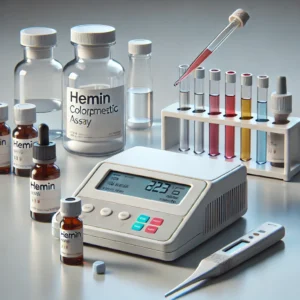
The Hemin Colorimetric Assay Kit is designed to quantitatively measure hemin concentration in biological samples. Hemin, the oxidized form of heme, plays a crucial role in biological processes, including oxygen transport, electron transfer, and enzymatic activity. Accurate quantification of hemin is essential for studying its function in physiological and pathological conditions, such as hemolytic disorders, oxidative stress, and certain metabolic diseases.
Key Features of the Hemin Colorimetric Assay Kit
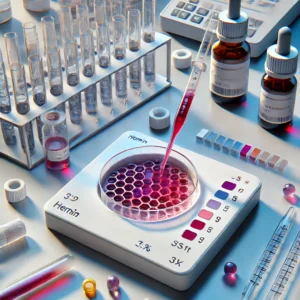
- Sensitive Colorimetric Detection: The kit uses a chromogenic reagent that reacts with hemin, producing a color change that is measured spectrophotometrically. The intensity of the color change is proportional to the concentration of hemin, allowing for precise quantification.
- Wide Sample Compatibility: This kit is compatible with various sample types, including plasma, serum, and tissue lysates. It is suitable for use in both clinical and research settings. For more information on handling biological samples, visit NIH.gov.
- Easy-to-Use Protocol: The assay is designed with a straightforward protocol, requiring minimal sample preparation and allowing for rapid quantification. Researchers can perform the entire assay in a few hours, making it ideal for high-throughput experiments. Explore basic assay principles at NCBI.

Applications of the Hemin Colorimetric Assay Kit
- Hematological Studies: Hemin is a breakdown product of hemoglobin, making this kit essential for studying red blood cell metabolism, hemolysis, and related disorders. Accurate measurement of hemin is critical in diagnosing and understanding diseases such as sickle cell anemia and thalassemia. Resources on hemolytic disorders can be found at NHLBI.
- Oxidative Stress Research: Hemin plays a role in oxidative stress as a pro-oxidant. This kit is used in studies exploring oxidative damage in cells, tissues, and organs. For protocols on measuring oxidative stress, visit CDC.gov.
- Metabolic Pathways: Researchers use the Hemin Colorimetric Assay Kit to investigate the role of hemin in metabolic pathways, particularly those related to heme oxygenase and cytochrome P450 enzymes. These pathways are crucial for detoxification and cellular respiration. For more detailed research on metabolic processes, refer to FDA.gov.
- Drug Development: This assay is valuable in drug development, particularly for screening compounds that affect heme metabolism, such as antimalarial drugs or treatments targeting hemoglobinopathies. For more information on drug screening assays, visit Science.gov.
Benefits of the Colorimetric Assay
- Quantitative and Reproducible: The colorimetric assay provides a quantitative readout that is highly reproducible, making it reliable for comparative studies.
- Non-Radioactive: Unlike some traditional assays for measuring heme, the Hemin Colorimetric Assay Kit does not require the use of radioactive compounds, offering a safer and more environmentally friendly option. Safety protocols for using non-radioactive assays can be found at EPA.gov.
- High Sensitivity: The kit’s formulation provides excellent sensitivity, allowing for the detection of low levels of hemin in biological samples. This is particularly useful for detecting subtle changes in heme metabolism in response to experimental treatments.
Protocol Overview
- Sample Preparation: Collect biological samples such as plasma, serum, or tissue lysates and prepare them according to the kit’s guidelines. The samples should be free from large debris or contaminants to ensure accurate results.
- More information on sample preparation protocols can be found at NIH’s Assay Guidelines.
- Reaction Setup: Add the chromogenic reagent to each sample and incubate according to the specified temperature and time. This allows the reagent to interact with hemin, resulting in a measurable color change.
- Standard reagent preparation guidelines are available at NCBI.
- Spectrophotometric Measurement: After incubation, measure the absorbance of each sample using a spectrophotometer at the recommended wavelength (typically between 400-450 nm). The absorbance values correlate with the concentration of hemin in the sample.
- Spectrophotometry guidelines and equipment calibration can be referenced at FDA.gov.
- Data Analysis: Use a standard curve to calculate the concentration of hemin in your samples. The standard curve is generated using known concentrations of hemin included in the kit. Data analysis protocols can be found at Science.gov.
Advantages of the Hemin Colorimetric Assay Kit
- Simple Workflow: The straightforward protocol makes the assay easy to use for both novice and experienced researchers. It does not require complicated sample preparation or expensive equipment.
- High Throughput: This assay can be easily scaled up for high-throughput applications, making it ideal for large-scale studies or screening multiple samples simultaneously.
- Fast Results: With a rapid reaction time and quick data analysis, researchers can obtain results within a few hours, making it efficient for time-sensitive experiments.
Considerations and Limitations
- Sample Interference: As with all colorimetric assays, certain compounds in biological samples may interfere with the color reaction, leading to inaccurate results. It is important to ensure that samples are free of contaminants that may affect the absorbance measurement. For troubleshooting tips, visit NIST.gov.
- Limited Sensitivity for Complex Samples: In samples with very complex matrices (e.g., whole blood or highly pigmented tissues), sensitivity may be reduced. Consider additional purification steps to improve assay accuracy in these cases. For sample cleanup protocols, visit PubMed.
Conclusion
The Hemin Colorimetric Assay Kit is a powerful tool for quantifying hemin in a wide range of biological samples. It offers a simple, sensitive, and reproducible method that is suitable for a variety of research applications, including hematology, oxidative stress studies, and drug development. With its user-friendly protocol and compatibility with multiple sample types, this kit is an essential addition to any laboratory working on heme metabolism or related fields.
